
Team Building with Rhythm: The power of a drum circle
Talking about teamwork around a conference table can only reveal so much about the way people actually work together. Put those same colleagues in a circle, hand each of them a percussion instrument and ask them to create a shared rhythm, and the dynamics can become surprisingly easy to observe.
That is the appeal of the drum circle, a musical team building activity in which every participant contributes to the same rhythm. No previous musical experience is needed, because the facilitator guides the group through the session and helps everyone find their place within the sound. What matters is the attention people pay to one another as the rhythm develops.
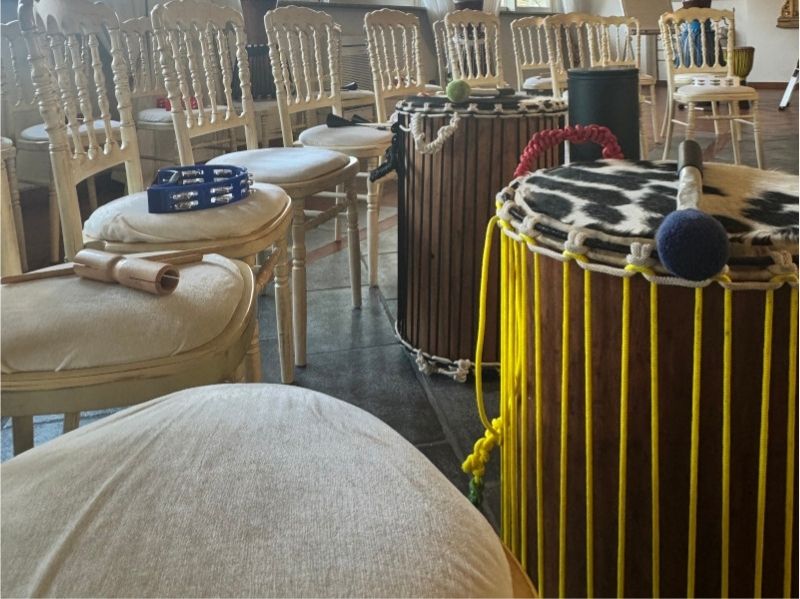
How a drum circle works
A typical session brings participants together in a circle with djembes and other percussion instruments, while a facilitator introduces rhythms and gradually involves the whole group. Everyone has a part to play, although that part can change as the session develops.
The absence of musical experience is part of what makes the format work so well. Participants can simply follow the facilitator, listen to the people around them and adjust their playing as the rhythm takes shape, without worrying about getting everything technically right.
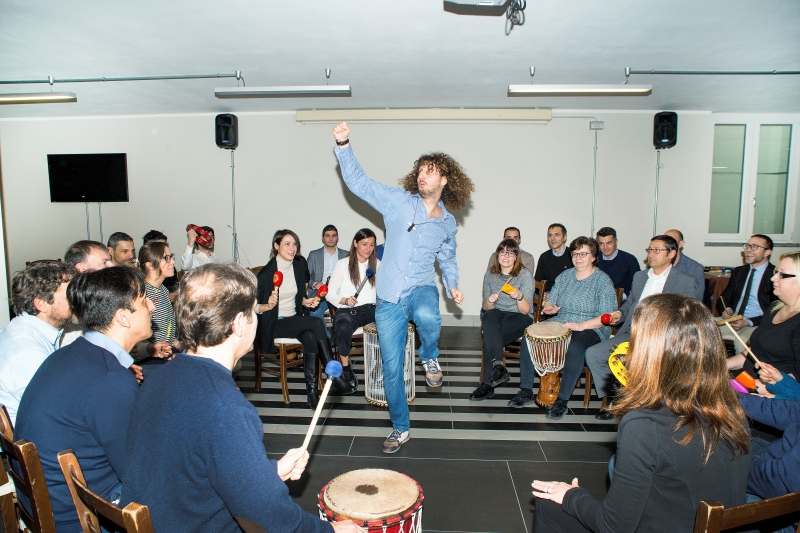
A drum circle can also reveal something that often takes much longer to see in an office: being good at your own job doesn't automatically mean that you work well as part of a group. Someone can have excellent timing on their own and still struggle to find the right moment when several people are playing around them, and this difference becomes immediately tangible because individual ability only takes the group so far.
What happens when everyone has the same role?
For the duration of the activity, professional titles have very little practical importance, since a managing director can be sitting next to someone who joined the company a few weeks earlier, with both responding to the same rhythm and contributing to the same piece of music. The same applies to all musical team building activities.
This creates an interesting environment in which familiar workplace behaviours can become easier to notice. Some people naturally take more space, while others tend to wait and observe, and everyone has to find the right way to interact with one another and make the music work as a group.

Listening becomes essential because the rhythm depends on it. If everyone concentrates exclusively on their own instrument, the result becomes difficult to follow; when participants pay attention to what is happening around them, they can adapt their contribution and leave room for other people when necessary.
A team building activity people can actually feel
For corporate teams, this makes the drum circle particularly useful. Ideas such as collaboration or coordination can feel rather abstract when they are discussed in a meeting room, whereas a musical session gives participants immediate feedback about how their behaviour affects the group.
Moreover, the activity can be adapted to different group sizes and venues, making it suitable for corporate events, team days and offsites. Depending on the setting, a session can take place indoors or outside, with the format adjusted to the atmosphere and practical requirements of the event. The Recycle Drum Circle is also interesting because it combines the goal of sustainability with that of strengthening group cohesion.
.jpg)
What rhythm can teach a working team
A drum circle offers a fairly direct demonstration of something that matters in everyday work: people have to recognise what is happening around them before they can decide how to contribute, even when they are busy and focused on their own deadlines and responsibilities.
During a drum session, the consequences are immediate. Someone playing too loudly can affect the rhythm around them, while someone who stops listening can lose the point at which their contribution fits naturally into the group. Participants can hear those changes as they happen, which makes the experience particularly revealing when they recognise familiar workplace behaviours in what happened during the session.
When the meeting room can wait
A drum circle will probably not turn your colleagues into the next Glastonbury headliners, and that is perfectly fine. Its value lies in creating a shared situation where everyone has a genuine role and where listening becomes essential to the experience and creates a competence.
Therefore, for companies considering a team building activity, a drum circle can offer an engaging way to bring colleagues together without asking them to sit through another workshop about communication. There is a facilitator, a room full of percussion instruments and a group of people trying to find the same rhythm. Just let the “magic” happen!