
Being colleagues isn't enough: why team building is now a strategic priority
Spend enough time dismissing team building and there's a kernel of truth in the critique. Yes, some events feel forced. Yes, some activities land awkwardly. Yes, everyone’s tired and nobody genuinely wants to spend two hours playing awkward icebreaker games, and that’s fair.
But when team building is well organised, the picture changes. For L&D executives, 13% of those who identified management skills as a priority now name team-building skills as a focus area, up from zero the year before, according to SHRM’s 2026 report. That’s a meaningful jump in a single year, and it signals something important: organisations are beginning to ask different questions about how people actually work together.

Beyond access: why training alone doesn't stick
For years, corporate learning has focused heavily on optimising the way learning is delivered: expanding the number of courses available on platforms, introducing gamification, creating more streamlined learning pathways, and making content increasingly concise and accessible.
Yet 40% of L&D leaders say that fostering a culture of learning across the organisation remains a significant challenge, while 17% consider it their greatest challenge. This gap between having access to learning opportunities and actually engaging with them points to a difficult reality: providing people with more ways to learn achieves very little if the environment around them does not give them the time, support and confidence to apply what they have learned in their day-to-day work. Motivation matters, and so does having the time and space to learn, but there is another factor that may matter even more: psychological safety. And that is something you cannot build inside an LMS; it develops through everyday interactions, relationships and, above all, within teams.
The colleagues versus team distinction
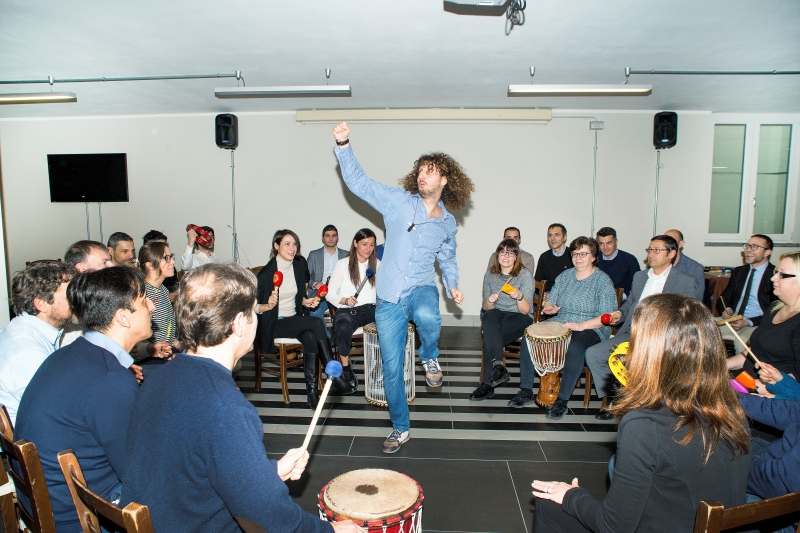
Two people sharing an office aren't yet a team, even with collaborative projects, email threads and the occasional lunch together. Being colleagues means showing up to the same meetings and respecting professional boundaries, whereas being a team means something riskier: knowing one another well enough to trust that vulnerability won't be punished, that mistakes will be handled constructively and that individual success serves a collective purpose. That distinction rarely develops within formal work settings, since most office environments demand a professional mask—composed, competent and appropriately distant. Outside that context, something shifts.
A dinner, an escape room, a river rafting trip or a creative building project won't inherently transform a group. What these experiences can do is create space for those masks to slip, allowing people to reveal dimensions of themselves that remain invisible behind a job title. This, in turn, can strengthen trust and team cohesion.

Solidarity and Sustainability: Values That Can No Longer Be Ignored
Even social and sustainability-focused team-building activities can no longer be considered mere add-ons, as CSR principles are becoming integral to how companies define their identity, their impact, and their relationships with employees and external stakeholders.
An activity built around a charitable initiative or an environmental project gives people the opportunity to contribute to something tangible while collaborating in ways that differ from their usual routines. They can see the impact of their collective effort firsthand, which gives the experience a sense of purpose that goes beyond the activity itself. In this context, team building can strengthen relationships within the group while creating value that extends well beyond it.

The data nudging organisations forward
For years, team building could be defended as "good for morale" or "investment in culture." Framing mattered because it existed in the soft benefits category, nice to have but not essential. Now, L&D executives are thinking about performance as a collective outcome, not just an individual one, which repositions team building from optional to foundational. Strong teams create the trust and accountability that turn learning into genuinely retained skill. Without them, access to training becomes another box ticked, another cost line, another initiative people endure rather than embrace.
Strong teams also create the conditions in which people can collaborate effectively and turn individual skills into collective results. Organisations looking to strengthen these dynamics can explore how cohesive teams are built through purposeful experiences.

What this actually looks like
Cohesive teams—and this is now well established—are better equipped to navigate challenges and achieve meaningful results, while a lack of cohesion can leave individuals less able to cope with pressure and more likely to lose motivation or experience burnout. Companies that understand this dynamic and create a work environment where relationships matter will be better placed to retain their talent, support their growth, reduce turnover and improve overall performance. And yes, team building can play a meaningful part in making all of this happen.
HTMLTEXT_BLOG-CTA-36:CONTENT NOT FOUND